6 Governance in Motion
6.1 Introduction
The AI governance frameworks presented in previous chapters assume a reasonably sequential development process with distinct phases allowing governance review at each stage. But the practice of building with AI is changing rapidly. Development cycles that once took months now take weeks or days. Tools enable individuals with limited technical training to build AI-powered applications. The boundaries between development and deployment blur as systems learn and adapt continuously. Governance approaches designed for deliberate, phased development struggle to keep pace.
This chapter examines “execution compression,” the phenomenon of development and deployment cycles compressing to timescales that challenge traditional governance approaches. It explores how governance must adapt to remain effective when development moves faster than traditional review cycles allow. The chapter presents patterns for embedded governance that operates within compressed timelines rather than alongside them, and it considers the implications of AI tools that expand who can build AI systems and how quickly.
This material addresses emerging challenges that the AIGP Body of Knowledge touches upon in its discussion of ongoing issues and that governance professionals will increasingly face as AI capabilities advance.
6.2 Understanding Execution Compression
Execution compression refers to the reduction in time required to move from idea to deployed AI capability. Where traditional software development might follow multi-month cycles with distinct requirements, design, development, testing, and deployment phases, modern AI development with advanced tools can compress this to days or hours.
Sources of Compression
Several factors drive execution compression.
Pre-trained models eliminate the need to train models from scratch for many applications. A developer can access powerful language models, image models, or other capabilities through APIs without gathering training data, designing model architecture, or conducting model training. The development task shifts from building AI to applying AI.
Low-code and no-code platforms enable people without deep technical expertise to create AI-powered applications. Visual interfaces, natural language instructions, and pre-built components reduce the skill and time required to build functional applications.
AI-assisted development uses AI to accelerate development itself. Code generation tools write code from natural language descriptions. Testing tools generate test cases automatically. Documentation tools produce documentation from code. Development tasks that previously required hours of skilled labor can be completed in minutes.
Cloud infrastructure eliminates provisioning delays. Computing resources are available instantly rather than requiring procurement and setup. Deployment can occur with a few clicks rather than requiring infrastructure preparation.
Continuous deployment practices push changes to production rapidly and frequently rather than accumulating changes for periodic releases. What was deployed weekly might now deploy multiple times daily.
Implications for Governance
Execution compression challenges governance in several ways.
Review cycles may be too slow. If development moves from idea to deployment in days, governance review cycles measured in weeks cannot provide pre-deployment scrutiny. Governance that arrives after deployment has already occurred provides limited value.
Sequential governance breaks down. Traditional governance assumes distinct phases where specific governance activities occur. When phases collapse into continuous flow, governance activities must be reorganized.
Scale of governance increases. When each developer can build and deploy AI applications rapidly, the volume of AI requiring governance increases dramatically. Governance processes designed for a handful of significant AI projects cannot scale to hundreds or thousands of small applications.
Accountability diffuses. When individuals can build and deploy AI without involving traditional development teams, the organizational roles that governance traditionally holds accountable may not be involved. Who is responsible for governance when anyone can build AI?
Change velocity increases. When systems change frequently, governance that assumed stable deployed systems must adapt to systems in constant flux.
6.3 Where Governance Gets Squeezed
When execution compresses, governance activities that previously fit comfortably into development timelines get squeezed. Understanding where compression creates the most pressure helps prioritize governance adaptation.
Impact Assessment
Traditional impact assessments require time to gather information, consult stakeholders, analyze risks, and document conclusions. A thorough impact assessment might take weeks. When development takes days, there is no time for traditional assessment.
The pressure point is not the assessment itself but the underlying goal: ensuring that significant risks are identified and addressed before deployment. The challenge is achieving that goal through means that fit compressed timelines.
Legal Review
Traditional legal review involves lawyers analyzing proposed AI applications against applicable requirements. For novel applications or significant risks, this review might require substantial legal analysis. When development moves faster than legal review, systems may deploy without legal scrutiny.
The pressure point is ensuring legal compliance without requiring extensive legal involvement in every AI application. This suggests need for clearer upfront guidance, automated compliance checking where possible, and risk-based triage to focus legal attention where it matters most.
Testing and Validation
Comprehensive testing requires time: time to design tests, execute tests, analyze results, and address issues. When development compresses, testing is often what gets squeezed. Systems deploy with less testing than governance would prefer.
The pressure point is ensuring adequate validation without requiring extensive testing time. This suggests need for automated testing, risk-proportionate testing requirements, and continuous testing approaches that validate throughout development rather than only at the end.
Documentation
Creating and maintaining governance documentation takes time. When development moves quickly, documentation often lags or is omitted entirely. Systems deploy without the documentation that governance policies require.
The pressure point is ensuring appropriate documentation exists without requiring extensive documentation effort. This suggests need for automated documentation generation, documentation integrated into development tools, and right-sized documentation requirements based on risk.
Human Oversight
Meaningful human oversight requires humans to have time to understand AI outputs, exercise judgment, and intervene when appropriate. When AI operates at machine speed on high volumes, human review of individual decisions becomes impossible.
The pressure point is ensuring meaningful human control without requiring humans to review every AI decision. This suggests need for risk-based determination of what requires human review, statistical monitoring as alternative to individual review, and intervention capabilities that enable humans to act when needed.
6.4 From Gatekeeping to Embedded Governance
Traditional governance operates through gatekeeping: review points where governance teams evaluate whether AI applications should proceed. Gatekeeping works when development moves slowly enough that review points do not create unacceptable delays. When execution compresses, gatekeeping becomes a bottleneck.
The alternative is embedded governance: governance mechanisms built into development processes and tools so that governance occurs as development occurs rather than alongside it.
Characteristics of Embedded Governance
Embedded governance is continuous rather than episodic. Rather than governance review at designated checkpoints, governance activities occur throughout development as integral parts of the process.
Embedded governance is automated where possible. Automated checks, automated documentation, automated monitoring reduce governance burden while ensuring governance activities actually occur.
Embedded governance is proportionate to risk. Not every AI application requires the same governance intensity. Embedded approaches apply light-touch governance to low-risk applications while escalating higher-risk applications for more intensive scrutiny.
Embedded governance is designed into tools and processes rather than being added alongside them. When governance is built into the development environment, compliance becomes the path of least resistance rather than an additional burden.
Examples of Embedded Governance
Risk-based routing automatically classifies proposed AI applications based on risk indicators and routes them to appropriate governance processes. Low-risk applications might proceed with minimal review while high-risk applications receive intensive scrutiny.
Automated policy checking validates proposed AI applications against defined policies. A tool might check whether proposed data use complies with data governance policies, whether required disclosures are planned, or whether prohibited use cases are being attempted.
Integrated documentation tools generate governance documentation from development artifacts rather than requiring separate documentation effort. Model cards, data sheets, and compliance documentation can be auto-populated from information already captured during development.
Continuous testing infrastructure runs governance-relevant tests automatically as part of development and deployment pipelines. Fairness tests, accuracy tests, and security tests execute automatically rather than requiring separate testing phases.
Real-time monitoring begins when deployment begins rather than being added afterward. Monitoring infrastructure is part of the deployment platform, not a separate system that must be integrated.
Automated compliance reporting aggregates information from development and deployment into reports that satisfy compliance requirements without manual report generation.
Implementing Embedded Governance
Moving from gatekeeping to embedded governance requires investment in several areas.
Policy codification translates governance policies into rules that can be checked automatically. This requires making policies precise enough to automate while preserving their intent.
Tool integration builds governance capabilities into development tools rather than operating separate governance systems. This may require working with tool vendors or building custom integrations.
Process redesign restructures development processes to incorporate governance activities rather than treating governance as a parallel track.
Metrics and monitoring establish visibility into whether embedded governance is operating effectively. Without visibility, embedded governance may fail silently.
Exception handling establishes how situations that embedded governance cannot handle automatically are escalated for human judgment. Embedded governance handles routine cases; humans handle exceptions.
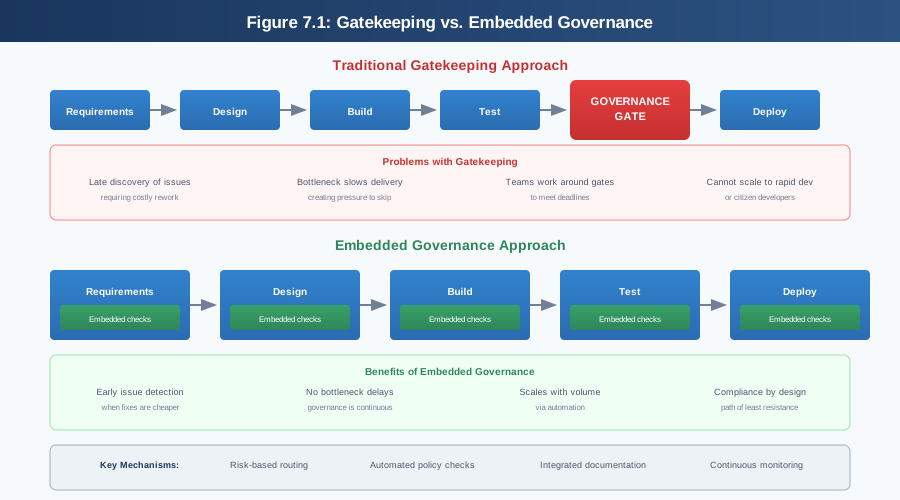
Figure 6.1: Gatekeeping vs. Embedded Governance — Comparison showing how embedded governance maintains coverage while enabling faster development.
6.5 Role Fluidity and Accountability Gaps
Execution compression and democratization of AI building create situations where traditional governance roles may not apply. Understanding these changes helps governance adapt.
Changing Developer Profiles
Traditionally, AI development required specialized skills: data science, machine learning engineering, and related expertise. Governance could assume that AI was built by technical teams who could be held accountable and who had some understanding of AI characteristics.
Today, AI capabilities are accessible to people without specialized training. A marketing professional can use AI tools to build a customer-facing chatbot. A analyst can use AI to automate data processing. A manager can use AI to generate reports. These “citizen developers” may not understand AI characteristics, risks, or governance requirements.
Governance must account for developers who may not know what they do not know. This suggests need for guardrails built into tools, simplified guidance for non-specialist developers, and mechanisms to identify AI built outside traditional channels.
Blurring of Build and Deploy
Traditional governance distinguished between development and deployment, with different governance activities appropriate to each. When systems update continuously, when deployment is automated, when there is no clear line between building and running, this distinction breaks down.
Governance must address continuous change rather than discrete releases. This suggests need for continuous monitoring rather than pre-deployment validation alone, automated regression testing that catches problematic changes, and rollback capabilities that can quickly undo harmful deployments.
Accountability in Tool-Mediated Development
When AI is built using pre-trained models, cloud services, and no-code platforms, responsibility distributes across multiple parties. The person who assembled the application, the vendor who provided the model, the platform that enabled deployment, the organization that deployed the result: all contributed, but who is accountable?
Governance must clarify accountability even when multiple parties are involved. This suggests need for clear contractual allocation of responsibility, organizational policies that assign accountability regardless of how AI was built, and vendor management that ensures external parties meet appropriate standards.
Governance for AI Agents
Emerging AI systems can take autonomous action, not just provide outputs for humans to act upon. AI agents can browse the web, execute code, interact with services, and accomplish multi-step tasks with minimal human involvement. These systems compress not just development but decision-making, with AI making choices that might previously have required human judgment.
Governance must address AI systems that act, not just AI systems that recommend. This suggests need for boundaries on what autonomous action AI can take, monitoring of AI actions not just AI outputs, and mechanisms to intervene when AI actions go wrong.
6.6 Tools Driving Compression and the Expanding Governance Surface
Specific categories of tools are driving execution compression and changing the governance landscape.
Large Language Models and Generative AI
Large language models have dramatically compressed the time required to generate text, code, analysis, and creative content. Tasks that required hours of skilled human effort can be completed in seconds.
Governance implications include potential for generation of harmful or inaccurate content at scale, intellectual property concerns when models produce content derived from training data, and difficulty attributing responsibility when AI generates outputs that cause harm.
AI-Assisted Development Tools
AI-assisted development tools, including code generation, automated testing, and intelligent development environments, compress development time and expand who can build software.
Governance implications include potential for generated code to contain security vulnerabilities or bugs, difficulty ensuring code quality when developers do not fully understand generated code, and need for governance to extend to AI-generated artifacts.
No-Code and Low-Code AI Platforms
No-code and low-code platforms enable non-technical users to build AI-powered applications through visual interfaces and pre-built components.
Governance implications include expansion of AI building beyond technical teams who traditionally bore governance responsibility, potential for applications built without understanding of AI characteristics or risks, and need for governance guardrails built into platforms.
API-Accessible AI Services
Cloud providers offer AI capabilities through APIs that developers can integrate into applications with minimal effort. Sentiment analysis, image recognition, language translation, and many other capabilities are available as services.
Governance implications include dependence on external services that may change without notice, difficulty ensuring external services meet governance requirements, and need for vendor management processes that address API services.
AI Agent Frameworks
Frameworks for building AI agents that can take autonomous action are emerging rapidly. These frameworks enable developers to create systems that can browse the web, execute code, manage files, and interact with external services.
Governance implications include potential for AI to take harmful actions without human review, difficulty predicting what autonomous agents will do, and need for boundaries and monitoring around autonomous AI action.
6.7 Governance Patterns for Compressed Execution
Several patterns help governance remain effective despite execution compression.
Risk-Based Triage
Not all AI applications require the same governance intensity. Risk-based triage quickly classifies applications and routes them to appropriate governance tracks.
Low-risk applications might proceed with minimal review, relying on built-in guardrails and automated checks. Medium-risk applications might require documented assessment and standard review. High-risk applications might require intensive scrutiny, legal review, and executive approval.
The key is quick, reliable classification that directs governance effort where it matters most.
Guardrails and Defaults
When governance cannot review every application, guardrails prevent the worst outcomes and defaults encourage appropriate behavior.
Guardrails are hard constraints that prevent certain actions: prohibited use cases blocked by policy, data access limited by technical controls, deployment restricted to approved environments. Guardrails operate automatically without requiring review.
Defaults are soft constraints that guide behavior toward appropriate choices: templates that include required elements, workflows that prompt for governance information, tools that suggest compliant approaches. Defaults can be overridden, but compliance is the path of least resistance.
Continuous Monitoring and Response
When pre-deployment review cannot be comprehensive, post-deployment monitoring provides ongoing assurance. Issues that review did not catch can be detected through monitoring and addressed through response.
Monitoring must operate at appropriate timescales. If systems change hourly, monitoring that reports weekly cannot keep pace. Real-time or near-real-time monitoring enables rapid response to emerging issues.
Response capabilities must match monitoring speed. Detecting a problem quickly provides limited value if response takes weeks. Automated response, rapid escalation, and pre-planned remediation enable timely action.
Progressive Rollout
Rather than deploying fully at once, progressive rollout deploys to increasing audiences over time. Initial deployment might serve a small percentage of users, expanding as confidence builds.
Progressive rollout limits the blast radius of problems. If an issue emerges, it affects fewer users than full deployment would have affected. The organization has opportunity to detect and address issues before they reach everyone.
Progressive rollout requires monitoring that can detect issues in partial deployment and mechanisms to expand or contract deployment based on observed behavior.
Automated Compliance Evidence
Governance often requires evidence that compliance activities occurred. Traditionally, this evidence was created through manual documentation. When development moves quickly, manual documentation becomes a bottleneck.
Automated systems can capture compliance evidence as a byproduct of development and deployment. Test results, configuration records, approval workflows, monitoring data: all can be captured automatically and aggregated into compliance records.
Automated evidence collection ensures evidence exists even when development moves too quickly for manual documentation.
6.8 Implementing Governance for Compressed Execution
Organizations must adapt governance practices to address execution compression while maintaining appropriate risk management.
Assess Current State
Begin by understanding how execution compression affects your organization. Which AI development happens through traditional channels with deliberate timelines? Which happens rapidly through self-service tools? Where are the gaps between current governance and actual development patterns?
This assessment may reveal AI applications that are not captured by current governance processes, development patterns that bypass established review points, or governance bottlenecks that teams are working around.
Establish Risk-Based Framework
Develop a risk classification framework that enables quick triage of AI applications. Define criteria that can be assessed rapidly, potentially through automated questionnaires or rule-based classification.
Map governance requirements to risk levels. Low-risk applications need minimal governance burden; high-risk applications need thorough review regardless of timeline pressure.
Build Embedded Capabilities
Identify governance activities that can be embedded into development processes and tools. Prioritize activities that are currently bottlenecks or that are frequently skipped due to time pressure.
Work with development tool owners to integrate governance capabilities. This might mean working with platform teams who manage internal tools, with vendors who provide commercial tools, or with both.
Strengthen Monitoring and Response
Invest in monitoring capabilities that can detect governance-relevant issues in deployed AI systems. Connect monitoring to response capabilities that can address issues quickly.
Establish escalation paths for issues that require human judgment. Not everything can be automated, and rapid escalation ensures human attention when needed.
Address the Expanding Developer Population
Develop governance approaches for non-specialist AI builders. This might include simplified guidance, required training, guardrails in self-service tools, or registration requirements for AI applications.
Create mechanisms to identify AI applications built outside traditional channels. If governance does not know about applications, governance cannot address them.
Maintain Accountability
Clarify accountability for AI outcomes regardless of how AI was built. Organizational accountability should not depend on development methodology.
Address vendor and platform accountability through contracts and vendor management. When AI depends on external services, governance must extend to those dependencies.
6.9 Chapter Summary
This chapter examined execution compression and its implications for AI governance, presenting approaches for governance that remains effective when development and deployment accelerate.
Execution compression results from pre-trained models, low-code platforms, AI-assisted development, cloud infrastructure, and continuous deployment practices. These factors reduce the time from idea to deployed AI capability from months to days or hours.
Compression challenges traditional governance by making review cycles too slow, breaking down sequential governance phases, increasing the scale of AI requiring governance, diffusing accountability, and increasing the velocity of change.
Governance gets squeezed in impact assessment, legal review, testing, documentation, and human oversight. Each area requires adaptation to fit compressed timelines while maintaining governance goals.
Embedded governance offers an alternative to gatekeeping. Rather than reviewing at checkpoints, embedded governance integrates governance activities into development processes and tools through automated checks, integrated documentation, continuous testing, and real-time monitoring.
Role fluidity creates accountability gaps as AI building expands beyond traditional development teams to include citizen developers using accessible tools. Governance must address developers who may not understand AI risks, continuous change rather than discrete releases, distributed accountability when multiple parties contribute, and AI agents that take autonomous action.
Specific tool categories driving compression include large language models, AI-assisted development tools, no-code platforms, API-accessible AI services, and AI agent frameworks. Each creates governance implications requiring attention.
Governance patterns for compressed execution include risk-based triage, guardrails and defaults, continuous monitoring and response, progressive rollout, and automated compliance evidence.
Implementing governance for compressed execution requires assessing current state, establishing risk-based frameworks, building embedded capabilities, strengthening monitoring and response, addressing the expanding developer population, and maintaining accountability.
6.10 Review Questions
An organization has established AI governance processes including a review committee that meets monthly to evaluate proposed AI applications. Development teams complain that the monthly cycle does not fit their sprint-based development approach, and some teams have begun deploying AI applications without committee review. What governance principle does this situation illustrate, and how might the organization respond?
A no-code platform enables marketing staff to create AI-powered chatbots for customer interaction. The platform is popular and multiple chatbots have been deployed. The governance team was not aware of these deployments until a customer complained about an inappropriate chatbot response. What governance challenge does this represent?
An organization is implementing embedded governance and wants to automate compliance checking for AI applications. Which types of governance requirements are most amenable to automated checking, and which require human judgment?
A deployed AI system updates its behavior based on continuous learning from user interactions. Traditional governance treated deployment as a point event followed by stable operation. How should governance adapt to continuous learning systems?
An AI agent framework enables developers to create systems that can browse the web, execute code, and interact with external services autonomously. What governance considerations are most important for AI agents compared to AI systems that only provide recommendations?
6.11 References
IAPP. AIGP Body of Knowledge, Version 2.0.1. International Association of Privacy Professionals, 2025.
Anthropic. “Claude’s Character.” Anthropic Research, 2024.
OpenAI. “GPT-4 System Card.” OpenAI Technical Report, 2023.
Google DeepMind. “Gemini: A Family of Highly Capable Multimodal Models.” Google DeepMind Technical Report, 2023.
Microsoft. “Responsible AI Standard, v2.” Microsoft Corporation, 2022.